When light photons are considered to be particles, what kind of path do they usually travel?
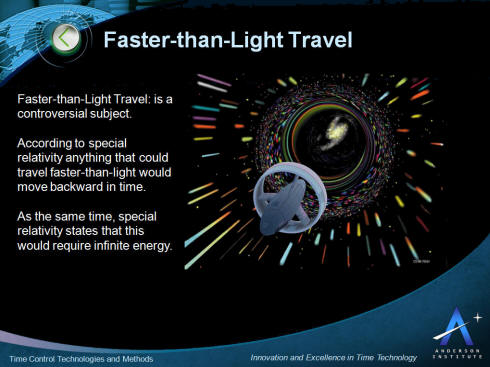
Faster-than-Light Travel is an interesting and controversial subject. According to special relativity anything that could travel faster-than-light would move backward in time. Every bit the same fourth dimension, special relativity states that this would require infinite energy.
Faster-than-calorie-free (too superluminal or FTL) communications and travel refer to the propagation of information or matter faster than the speed of light. Under the special theory of relativity, a particle (that has mass) with subluminal velocity needs infinite free energy to accelerate to the speed of lite, although special relativity does not forestall the being of particles that travel faster than light at all times.
On the other hand, what some physicists refer to as "credible" or "effective" FTL is the hypothesis that unusually distorted regions of spacetime might permit matter to reach distant locations faster than what it would accept lite in the "normal" road (though however moving subluminally through the distorted region).
Apparent FTL is non excluded by general relativity. Examples of apparent FTL proposals are the Alcubierre drive and the traversable wormhole, although the physical plausibility of these solutions is uncertain.
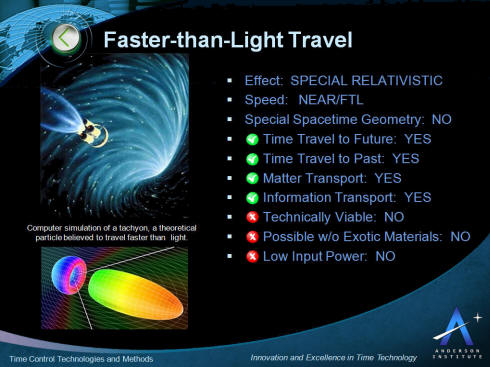
The key characteristics of the awarding of faster-than-light travel for fourth dimension control and time travel are presented in the picture below. This is followed by more particular describing the upshot beneath.
Exterior of mainstream physics, others have speculated on mechanisms that might let FTL travel to be accomplished, oftentimes relying on new conjectures of physics of their ain invention, but their ideas take not gained significant credence in the physics research customs. Fictional depictions of superluminal travel and the mechanisms of achieving it are also a staple of the scientific discipline fiction genre.
Travel
In the context of this article, FTL is transmitting information or matter faster than c, a constant equal to the speed of low-cal in a vacuum, 299,792,458 meters per second, or about 186,282 miles per second. This is non quite the aforementioned as traveling faster than light, since:
- Some processes propagate faster than c, only cannot carry information.
- Light travels at speed c/n when not in a vacuum merely traveling through a medium with refractive index = northward (causing refraction), and in some materials other particles can travel faster than c/n (but still slower than c), leading to Cherenkov radiation.
Neither of these phenomena violates special relativity or creates problems with causality, and thus neither qualifies every bit FTL equally described here.
Possibility
Faster-than-light communication is, by Einstein'southward theory of relativity, equivalent to time travel. According to Einstein's theory of special relativity, what we measure as the speed of light in a vacuum is actually the fundamental physical abiding c. This ways that all observers, regardless of their relative velocity, volition always measure zero-mass particles such as photons traveling at c in a vacuum. This result means that measurements of time and velocity in different frames are no longer related merely by constant shifts, just are instead related by Poincaré transformations. These transformations have important implications:
- The relativistic momentum of a massive particle would increment with speed in such a manner that at the speed of lite an object would have infinite momentum.
- To accelerate an object of non-zero residuum mass to c would require infinite fourth dimension with whatsoever finite acceleration, or infinite acceleration for a finite amount of time.
- Either way, such acceleration requires space free energy. Going beyond the speed of low-cal in a homogeneous space would hence require more than space energy, which is not generally considered to be a sensible notion.
- Some observers with sub-low-cal relative move will disagree about which occurs first of whatsoever two events that are separated past a space-like interval. In other words, any travel that is faster-than-low-cal will exist seen as traveling backwards in time in some other, equally valid, frames of reference, or need to assume the speculative hypothesis of possible Lorentz violations at a presently unobserved scale (for instance the Planck scale). Therefore whatsoever theory which permits "true" FTL also has to cope with time travel and all its associated paradoxes, or else to assume the Lorentz invariance to be a symmetry of thermodynamical statistical nature (hence a symmetry broken at some shortly unobserved scale).
- While Special and general relativity exercise non permit superluminal speeds locally, non-local means may be possible, which means moving with space rather than moving through infinite.
Justifications
Despite the established conclusion that relativity precludes FTL travel, some have proposed ways to justify FTL behavior:
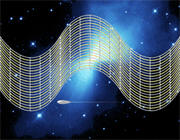
Radically Curve Spacetime Using Slip Cord Drive
Ignore special relativity
This option is pop peculiarly in scientific discipline fiction. Yet, empirical and theoretical show strongly supports Einstein'due south theory of special relativity as the right description of high-speed motion, which generalizes the more familiar Galilean relativity, which is actually an approximation at conventional (much less than c) speeds. Similarly, full general relativity is an overwhelmingly supported and experimentally verified theory of gravitation, except in the regime of very high energy densities over very short distances, where an as-nonetheless-undeveloped theory of breakthrough gravity is necessary. Special relativity, however, is incorporated easily into quantum field theories. Therefore, even in the broader contexts of general relativity and breakthrough mechanics, conventional acceleration from subluminal to superluminal speeds is not possible.
Faster light (Casimir vacuum and quantum tunneling)
Einstein's equations of special relativity postulate that the speed of low-cal in a vacuum is invariant in inertial frames. That is, it will be the same from whatever frame of reference moving at a constant speed. The equations do not specify any item value for the speed of the light, which is an experimentally adamant quantity for a fixed unit of length. Since 1983, the unit of length (the meter) has been divers using the speed of light.
The experimental determination has been made in vacuum. Withal, the vacuum we know is non the merely possible vacuum which can exist. The vacuum has free energy associated with information technology, called the vacuum energy. This vacuum energy tin can perhaps be inverse in certain cases. When vacuum free energy is lowered, light itself has been predicted to go faster than the standard value 'c'. This is known as the Scharnhorst effect. Such a vacuum can exist produced by bringing two perfectly shine metallic plates together at almost atomic diameter spacing. It is chosen a Casimir vacuum. Calculations imply that light will become faster in such a vacuum by a minuscule amount: a photon traveling between two plates that are 1 micrometer apart would increase the photon'south speed past only virtually one part in 1036. Accordingly there has as yet been no experimental verification of the prediction. A recent analysis argued that the Scharnhorst upshot cannot be used to send data backwards in fourth dimension with a single set up of plates since the plates' rest frame would ascertain a "preferred frame" for FTL signaling. However, with multiple pairs of plates in motion relative to one another the authors noted that they had no arguments that could "guarantee the total absence of causality violations", and invoked Hawking'south speculative chronology protection theorize which suggests that feedback loops of virtual particles would create "uncontrollable singularities in the renormalized quantum stress-energy" on the boundary of whatever potential fourth dimension motorcar, and thus would require a theory of quantum gravity to fully analyze. Other authors argue that Scharnhorst's original analysis which seemed to show the possibility of faster-than-c signals involved approximations which may be wrong, so that it is not articulate whether this effect could actually increase signal speed at all.
The physicists Günter Nimtz and Alfons Stahlhofen, of the University of Koblenz, claim to accept violated relativity experimentally by transmitting photons faster than the speed of light. They say they take conducted an experiment in which microwave photons - relatively depression energy packets of light - travelled "instantaneously" between a pair of prisms that had been moved upwards to 3 ft apart, using a miracle known as quantum tunneling. Nimtz told New Scientist magazine: "For the fourth dimension being, this is the but violation of special relativity that I know of." Even so, other physicists say that this miracle does non allow information to be transmitted faster than light. Aephraim Steinberg, a quantum optics expert at the Academy of Toronto, Canada, uses the analogy of a railroad train traveling from Chicago to New York, merely dropping off train cars at each station forth the way, and so that the center of the train moves frontwards at each stop; in this fashion, the speed of the middle of the railroad train exceeds the speed of any of the individual cars.
Give up causality
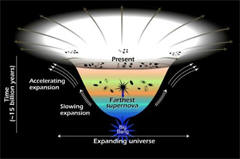
An important betoken to notation is that in full general relativity it is possible for objects to be moving apart faster than light because of the expansion of the universe, in some reasonable pick of cosmological coordinates. This is understood to be due to the expansion of the infinite between the objects, and general relativity however reduces to special relativity in a "local" sense, significant that ii objects passing each other in a small local region of spacetime cannot have a relative velocity greater than c, and volition motility more than slowly than a light beam passing through the region.
Give upwards (absolute) relativity
Considering of the strong empirical support for special relativity, whatsoever modifications to it must necessarily be quite subtle and difficult to measure. The all-time-known attempt is doubly-special relativity, which posits that the Planck length is as well the same in all reference frames, and is associated with the work of Giovanni Amelino-Camelia and João Magueijo. One issue of this theory is a variable speed of light, where photon speed would vary with energy, and some aught-mass particles might possibly travel faster than c. Nonetheless, even if this theory is accurate, it is still very unclear whether it would allow information to be communicated, and appears non in any case to allow massive particles to exceed c.
There are speculative theories that merits inertia is produced by the combined mass of the universe (e.one thousand., Mach's principle), which implies that the balance frame of the universe might be preferred past conventional measurements of natural police force. If confirmed, this would imply special relativity is an approximation to a more full general theory, but since the relevant comparison would (by definition) be outside the appreciable universe, it is difficult to imagine (much less construct) experiments to test this hypothesis.
Non-physical realms
A very popular option in infinite opera is to assume the existence of some other realm (typically called hyperspace, subspace, or slipspace) which is accessible from this universe, in which the laws of relativity are usually distorted, bent, or nonexistent, facilitating rapid transport between distant points in this universe, sometimes with dispatch differences - that is, not requiring equally much energy or thrust to get faster. To attain rapid ship betwixt points in hyperspace/subspace, special relativity is frequently assumed not to apply in this other realm, or that the speed of light is higher. Another solution is to posit that distant points in the mundane universe correspond to points that are close together in hyperspace.
This method of faster-than-lite travel does not correspond to anything seriously proposed by mainstream science.
Space-fourth dimension distortion
Although the theory of special relativity forbids objects to have a relative velocity greater than low-cal speed, and general relativity reduces to special relativity in a local sense (in small regions of spacetime where curvature is negligible), full general relativity does allow the infinite between distant objects to aggrandize in such a way that they have a "recession velocity" which exceeds the speed of light, and it is thought that galaxies which are at a distance of more than about fourteen billion calorie-free years from us today take a recession velocity which is faster than light. Miguel Alcubierre theorized that it would exist possible to create an Alcubierre drive, in which a ship would be enclosed in a "warp bubble" where the infinite at the front of the bubble is rapidly contracting and the infinite at the back is rapidly expanding, with the consequence that the bubble can reach a distant destination much faster than a calorie-free beam moving exterior the bubble, but without objects inside the bubble locally traveling faster than light. Nevertheless, several objections raised confronting the Alcubierre drive appear to rule out the possibility of actually using it in any practical manner. Another possibility predicted past full general relativity is the traversable wormhole, which could create a shortcut between arbitrarily distant points in space. As with the Alcubierre drive, travelers moving through the wormhole would not locally move faster than light which travels through the wormhole alongside them, but they would be able to reach their destination (and return to their starting location) faster than light traveling outside the wormhole.
Dr. Gerald Cleaver, associate professor of physics at Baylor Academy, and Richard Obousy, a Baylor graduate educatee, theorize that past manipulating the extra spatial dimensions of string theory around a spaceship with an extremely large corporeality of free energy, information technology would create a "bubble�? that could cause the transport to travel faster than the speed of light. To create this chimera, the physicists believe manipulating the tenth spatial dimension would alter the nighttime free energy in three big spatial dimensions: height, width and length. Cleaver said positive dark energy is currently responsible for speeding upwardly the expansion charge per unit of our universe every bit time moves on.
Heim theory
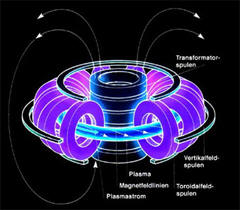
Quantized space and fourth dimension
As given past the Planck length, there is a minimum corporeality of 'space' that tin can exist in this universe (1.616×10⁻³⁵ meters). This limit can be used to make up one's mind a minimum time quantization of 5.391×ten−44 seconds, which corresponds to a axle of light with a wavelength approaching the Planck length. This ways that there is a physical limit to how much blue shift a beam of light can endure. Co-ordinate to general relativity in that location is no limit to this shift, and an infinitesimally pocket-size space can be, but co-ordinate to well accepted quantum theory these limits exercise exist.
This is precisely what happens towards the center of a blackness hole; the incoming light becomes blue shifted past the Planck length as it approaches the region of discontinuity within our universe. The argument is: if a blackness hole with finite mass tin can create such a discontinuity in the fabric of infinite and fourth dimension, why would people exist unable to exercise the same matter using a finite amount of free energy and acceleration? (According to general relativity, the space-time distortions caused past gravity are fundamentally identical to infinite-fourth dimension distortions caused only by accelerating your reference frame).
Tachyons
Full general relativity
Full general relativity was developed subsequently special relativity to include concepts similar gravity. Information technology maintains the principle that no object can accelerate to the speed of light in the reference frame of any coincident observer. Notwithstanding, it permits distortions in spacetime that allow an object to motion faster than lite from the point of view of a afar observer. I such distortion is the Alcubierre drive, which tin be thought of as producing a ripple in spacetime that carries an object along with it. Some other possible arrangement is the wormhole, which connects ii distant locations as though by a shortcut. Both distortions would demand to create a very strong curvature in a highly localized region of infinite-time and their gravity fields would exist immense. To counteract the unstable nature, and prevent the distortions from collapsing nether their own 'weight', i would demand to introduce hypothetical exotic thing or negative free energy.
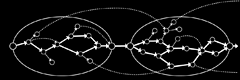
General relativity also agrees that whatsoever technique for faster-than-light travel could also exist used for time travel. This raises problems with causality. Many physicists believe that the above phenomena are in fact impossible, and that time to come theories of gravity will prohibit them. One theory states that stable wormholes are possible, but that whatever effort to apply a network of wormholes to violate causality would result in their decay. In string theory Eric Gimon and Petr Hořava have argued that in a supersymmetric 5-dimensional Gödel universe quantum corrections to full general relativity effectively cut off regions of spacetimes with causality-violating closed timelike curves. In particular, in the breakthrough theory a smeared supertube is nowadays that cuts the spacetime in such a style that, although in the full spacetime a closed timelike curve passed through every point, no consummate curves exist on the interior region bounded by the tube.
FTL phenomena
In these examples, sure influences may appear to travel faster than light, but they do not convey energy or information faster than light, and so they do not violate special relativity.Daily movement of the Heavens
Light spots and shadows
If a laser is swept across a afar object, the spot of calorie-free can easily be fabricated to motion at a speed greater than c. Similarly, a shadow projected onto a distant object tin exist fabricated to move faster than c. In neither case does whatever matter or data travel faster than low-cal.Closing speeds
An observer may conclude that two objects are moving faster than the speed of light relative to each other, by adding their velocities co-ordinate to the principle of Galilean relativity.For example, two fast-moving particles approaching each other from reverse sides of a particle accelerator will announced to be moving at slightly less than twice the speed of low-cal, relative to each other, from the point of view of an observer continuing at rest relative to the accelerator. This correctly reflects the rate at which the distance between the two particles is decreasing, from the observer's point of view and is chosen the closing speed. All the same, it is non the same every bit the velocity of 1 of the particles as would be measured by a hypothetical fast-moving observer traveling alongside the other particle. To obtain this, the calculation must exist done according to the principle of special relativity. If the two particles are moving at velocities v and -v, or expressed in units of c, β and − β, where

then this relative velocity (once again in units of the speed of light c) is
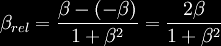
which is less than the speed of light.
Proper speeds
If a spaceship travels to a planet one lite year (as measured in the Earth's rest frame) away from Earth at high speed, the time taken to attain that planet could be less than 1 year as measured by the traveler'due south clock (although information technology will always be more than one year every bit measured by a clock on Earth). The value obtained by dividing the distance travelled, every bit adamant in the Earth'south frame, by the time taken, measured by the traveler'due south clock, is known every bit a proper speed or a proper velocity. There is no limit on the value of a proper speed as a proper speed does not stand for a speed measured in a single inertial frame. A light point that left the World at the same time as the traveler would ever become to the destination before the traveler.Phase velocities above c
Group velocities above c
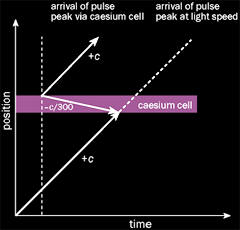
The group velocity of a wave (due east.g. a light axle) may also exceed c in some circumstances. In such cases, which typically at the same fourth dimension involve rapid attenuation of the intensity, the maximum of the envelope of a pulse may travel with a velocity higher up c. Withal, even this situation does non imply the propagation of signals with a velocity to a higher place c, even though one may be tempted to acquaintance pulse maxima with signals. The latter association has been shown to be misleading, basically because the information on the arrival of a pulse tin be obtained before the pulse maximum arrives. For example, if some mechanism allows the total transmission of the leading function of a pulse while strongly attenuating the pulse maximum and everything behind, the pulse maximum is effectively shifted forward in time, while the information on the pulse does not come faster than without this effect.Universal expansion
Astronomical observations
Credible superluminal motion is observed in many radio galaxies, blazars, quasars and recently likewise in microquasars. The effect was predicted before it was observed by Martin Rees and can be explained as an optical illusion caused by the object partly moving in the direction of the observer, when the speed calculations assume it does non. The phenomenon does not contradict the theory of special relativity. Interestingly, corrected calculations testify these objects have velocities close to the speed of light (relative to our reference frame). They are the first examples of large amounts of mass moving at close to the speed of lite. World-bound laboratories have only been able to advance pocket-size numbers of elementary particles to such speeds.Breakthrough mechanics
Sure phenomena in quantum mechanics, such equally quantum entanglement, appear to transmit information faster than light. According to the No-communication theorem these phenomena exercise not allow true communication; they only let 2 observers in different locations encounter the aforementioned event simultaneously, without any manner of controlling what either sees. Wavefunction collapse tin can be viewed equally an epiphenomenon of quantum decoherence, which in plough is naught more than an outcome of the underlying local fourth dimension evolution of the wavefunction of a system and all of its surroundings. Since the underlying beliefs doesn't violate local causality or let FTL it follows that neither does the additional effect of wavefunction plummet, whether real or credible.The uncertainty principle implies that private photons may travel for short distances at speeds somewhat faster (or slower) than c, even in a vacuum; this possibility must be taken into account when enumerating Feynman diagrams for a particle interaction. To quote Richard Feynman:
… there is also an amplitude for low-cal to go faster (or slower) than the conventional speed of light. You lot found out in the terminal lecture that light doesn't become only in straight lines; now, you find out that it doesn't go only at the speed of calorie-free! It may surprise you that there is an amplitude for a photon to become at speeds faster or slower than the conventional speed, c. – Richard Feynman
Nevertheless, macroscopically these fluctuations average out, so that photons do travel in direct lines over long (i.e. non-breakthrough) distances, and they practice travel at the speed of calorie-free on average. Therefore, this does not imply the possibility of superluminal information transmission.
There have been various reports in the pop printing of experiments on faster-than-lite transmission in eyes—most frequently in the context of a kind of quantum tunneling phenomenon. Usually, such reports deal with a stage velocity or group velocity faster than the vacuum velocity of low-cal. Simply, recall from above, that a superluminal phase velocity cannot be used for faster-than-light manual of information. At that place has sometimes been confusion concerning the latter point.
Say you take iv pairs of entangled thing such that (x0,y0) are distinct from and won't affect (x1,y1), (x2,y2), etc. If y0 changes you know that x0 changed, the aforementioned being true for the other pairs. Right there you have a crumb's worth of data transfer whatever fourth dimension x0, x1, x2, etc. are inverse immediately altering y0, y1, and y2 respectively. Monitoring the y bits will immediately tell you lot when the entangled x bits are updated. – SkewsMe.com
Hartman effect
The Hartman Effect
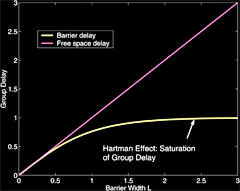
However, an analysis by Herbert Winful from the University of Michigan suggests that the Hartman upshot cannot really exist used to violate relativity by transmitting signals faster than c, because the tunneling time "should not be linked to a velocity since evanescent waves do non propagate". Winful means by this that the photons crossing the barrier are virtual photons only existing in the interaction and could not be propagated into the outside earth.
Casimir outcome
In physics, the Casimir effect or Casimir-Polder force is a physical force exerted between separate objects due to resonance of vacuum energy in the intervening space between the objects. This is sometimes described in terms of virtual particles interacting with the objects, due to the mathematical class of 1 possible style of calculating the force of the effect. Because the strength of the force falls off rapidly with distance, information technology is only measurable when the distance betwixt the objects is extremely modest. Energy appears suddenly as if information technology came from the vacuum. See Option B above for a discussion of whether or not this event could actually be used to send signals faster than c or violate causality.EPR Paradox
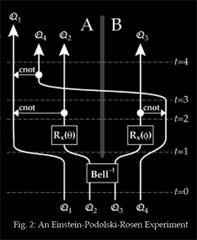
An experiment performed in 1997 by Nicolas Gisin at the University of Geneva has demonstrated nonlocal quantum correlations between particles separated by over 10 kilometers. But as noted before, the nonlocal correlations seen in entanglement cannot actually be used to transmit classical information faster than light, so that relativistic causality is preserved; see no-communication theorem for further information. A 2008 quantum physics experiment besides performed by Nicolas Gisin and his colleagues in Geneva, Switzerland has determined that the "speed" of the quantum non-local connectedness (what Einstein chosen spooky action at a distance) has a minimum lower spring of 10,000 times the speed of light.
Delayed selection quantum eraser
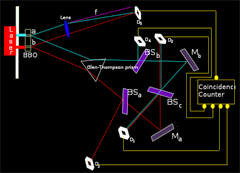
Delayed Pick Quantum Eraser
Variable speed of light
In conventional physics, the speed of lite in a vacuum is assumed to be a constant. There exist theories which postulate that the speed of light is not a abiding. The estimation of this statement is as follows. 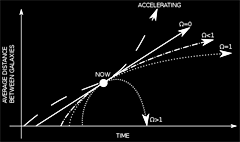
Variable Speed of Calorie-free
Magueijo'southward proposal used a unlike fix of units, a choice which he justifies with the claim that some equations will be simpler in these new units. In the new units he fixes the fine structure constant, a quantity which some people, using units in which the speed of lite is fixed, have claimed is time dependent. Thus in the arrangement of units in which the fine structure abiding is stock-still, the observational claim is that the speed of light is time-dependent.
While it may exist mathematically possible to construct such a system, it is not clear what additional explanatory power or physical insight such a system would provide, assuming that it does indeed accord with existing empirical information.
Source: https://www.andersoninstitute.com/faster-than-light-travel.html
0 Response to "When light photons are considered to be particles, what kind of path do they usually travel?"
Post a Comment